

Introduction
Worm like shapes in vision is an interesting yet scary topic of discussion. Have you ever looked at a bright sky or white background and wondered, “Why are there tiny worms floating in my eyes?” It’s interestingly a common thing- many people see the same thing and please don’t worry they are not parasites. Transparent worm-like shapes can be seen in the eye and they are known as eye floaters. Understanding eye floaters vs parasites can help you stay calm and know when medical attention is actually needed.
What are Worm-like shapes in Vision?
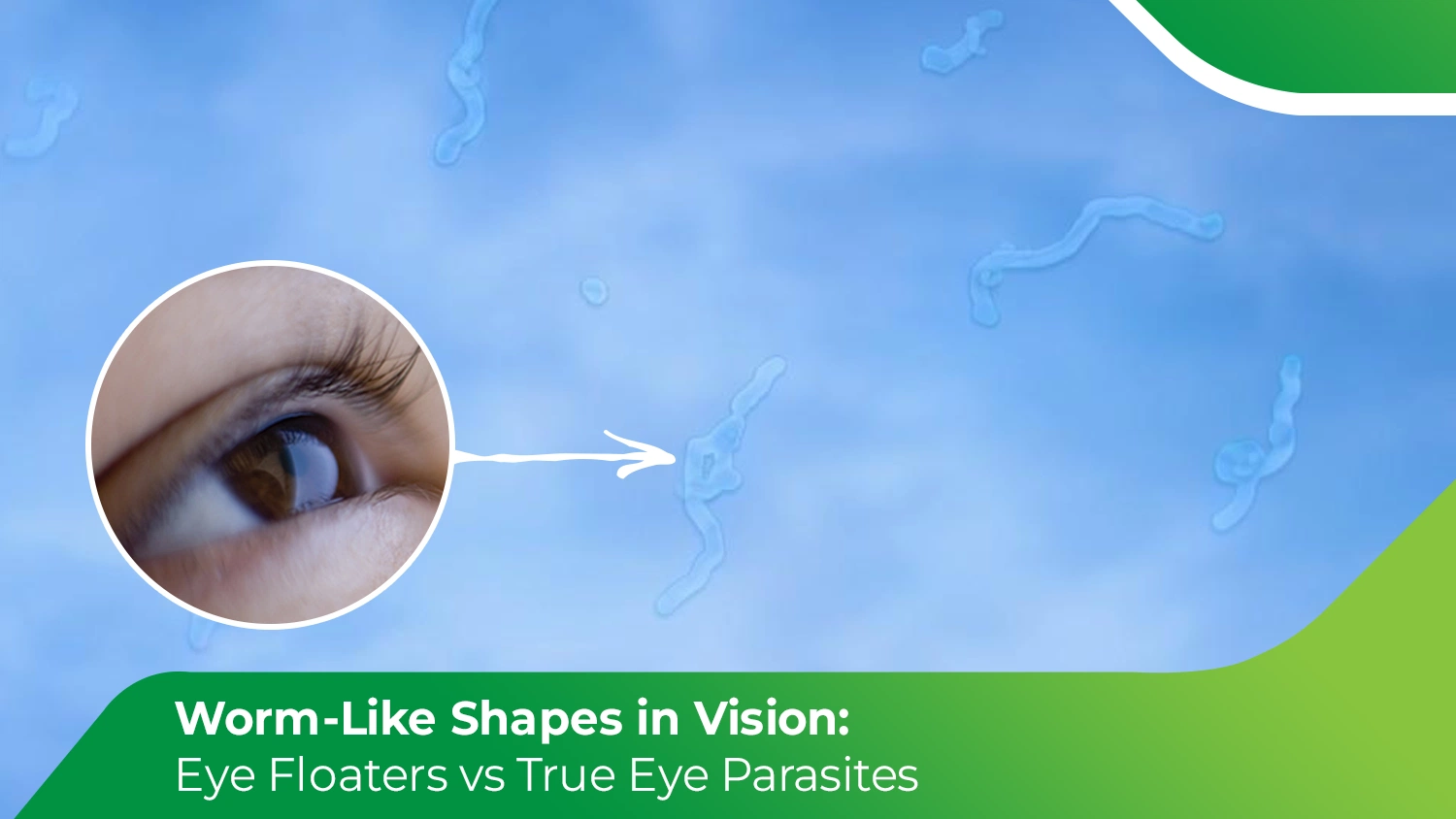
Worm-like shapes in eyesight are also known as eye floaters. They are small specks, strands or clouds of particles that move across your field of vision. People usually report moving lines, squiggly shapes in vision and that is what eye floaters are. They might look like cobwebs, a simple and best example of eye floaters. They might drift away when you move your eyes. These shapes that you can see are not actually in your eye. They are just an interpretation of what your brain thinks when there are tiny particles in the eye’s vitreous gel. When light enters the eyes, these particles cast shadow on the retina which is interpreted as squiggly shapes in the vision.

Eye Floaters-The Most Common Cause
Do you know what eye floaters are? Let me tell you
Eye Floaters are small spots, specks or cobwebs that drift through your field of vision, they are only noticed against bright backgrounds. They usually look like:
- Small spots
- Vitreous floaters
- Dots or cobwebs
- Black strings or transparent threads in vision
They do not affect your vision but just bring in fear among individuals. If they are too big they can make a shadow over your eyes. This can happen only in some types of light. Age is a factor that influences eye floaters.
What causes Eye Floaters?
Eye floaters are majorly caused by changes over time to the vitreous gel inside your eye and age factor. Vitreous gel is attached to the retina. Major causes of Eye floaters:
- Age-factor: Eye floaters can be caused by changes associated with aging eyes
- Inflammation behind the retina of the eye
- Bleeding eyes
- Torn retina
- Eye surgeries and eye medications
- Posterior vitreous detachment where the vitreous slowly detaches from the retina
Why do eye floaters look like worms?
Eye floaters are strands of collagen that are in the vitreous gel. When the collagen strands come together and form a clump they cast shadow over the retina which feels like worms. Most people address eye floaters as transparent worms in vision because of its shape and movement. As people age, the vitreous humor shrinks and liquifies making the collagen strands look like elongated worms. As the eyes move the floaters tend to move as well. Because of their irregular shapes they tend to be presumed as worms. While they might look like worms they are quite harmless, microscopic tiny particles of tissues and not living organisms.
Are Eye Floaters Dangerous?
In most of the cases, eye floaters are normal and don’t require treatment. If you observe frequent and sudden increase in eye floaters along with flashes of light this is an indication that there can be something dangerous like retinal detachment. While most of the eye floaters are common and benign, new, frequent or numerous floaters need immediate healthcare assistance.
True Eye Parasites-Rare but Real
Many people think that eye parasites are fake …. Unfortunately they are not. Although they are quite rare, there are eye parasites in humans. An eye parasite refers to a small organism living in the eye that infects and affects the eye and the surrounding areas. Ocular parasites are rare but serious conditions that are known as ocular parasitic infections. Certain parasites affect the conjunctiva, eyelids, iris, retina, sclera and other parts of the eye. Most of the parasites do not survive in the eye conditions easily, that is the reason these infections are uncommon.
Types of Eye Parasites
Different types of eye parasites are:
- Loiasis
Loiasis is caused by a worm named Loa Loa. Loa loa is a worm found in West and Central Africa which is transmitted to humans through the bite of infected deer flies. The worm is sometimes seen moving from the white part of the eye. Iverheal 12 mg is one of the options to treat Loiasis.
- River Blindness
Onchocerciasis also known as river blindness is a neglected tropical disease that is caused by the nematode Onchocerca volvulus. It is one of the second leading causes of blindness due to infection in the world. Iverheal 12 mg could be used to treat Onchocerciasis.
- Toxoplasmosis
Toxoplasmosis is a parasitic infection that is caused by a protozoa Toxocara. These parasites are usually found in cats and dogs. Iverheal 12 mg can be used to treat the condition if prescribed by the physician.
Symptoms
Symptoms of eye floaters may include:
- Small shapes in your vision that appear as dark specks or knobby, transparent strings of floating material
- Spots that move when you move your eyes, so when you try to look at them, they move quickly out of your line of vision
- Spots that are most noticeable when you look at a plain bright background, such as a blue sky or a white wall
- Small shapes or strings that eventually settle down and drift out of the line of vision
Eye Floaters vs Eye Parasites (Key Differences)
Difference between eye floaters and parasites are:
| Eye floaters | Parasites |
| Painless | Painful |
| Symptoms such as dark specks, transparent strips, etc | Symptoms such as pain, redness and visible inflammation |
| They are internal shadows | They are physical organisms |
Knowing how to tell eye floaters from parasites often comes down to symptoms and movement.
When Should You See an Eye Doctor?
You can consult an ophthalmologist only when emergency eye symptoms are seen like:
- Light flashes
- Frequent and sudden shower of floaters
- Vision loss
- Dark curtain effect
- Eye pain or redness
- Inflammation
Diagnosis and Treatment Options
To identify the cause, healthcare professionals may perform:
- A detailed eye exam
- Retinal imaging or eye ultrasound
Eye floaters treatment usually isn’t required unless they severely affect vision. In rare cases, laser therapy or vitrectomy may be considered.
For parasites, treatment may involve medication like Iverheal 12 mg or parasite removal by a specialist.
Can Anxiety or Stress Make Eye Floaters Worse?
Yes. Anxiety and eye floaters are closely linked. Stress doesn’t create floaters, but it increases awareness of them. Stress vision symptoms can make existing floaters seem larger, more frequent, or more disturbing.
Conclusion
Seeing worm-like shapes in vision is usually harmless and most often caused by eye floaters. While eye floaters vs eye parasites can feel confusing and alarming, parasites are rare and come with very different symptoms. If changes are sudden, painful, or affect your vision, seek professional care but in most cases, these visual disturbances are a normal part of aging eyes.
FAQs
1. How are eye floaters treated?
Eye floaters can be treated by medications like Iverheal 12 mg, surgery or laser treatment.
2. Can eye floaters be prevented?
Eye floaters cannot be prevented, they are usually related to age.
3. Are eye parasites rare?
Yes. Eye parasites are quite rare in comparison to other parasites.
4. Can rubbing your eyes increase eye floaters?
Rubbing your eyes won’t increase eye floaters, it will increase the pressure in the eye and make it more noticeable.
Leave a Comment