
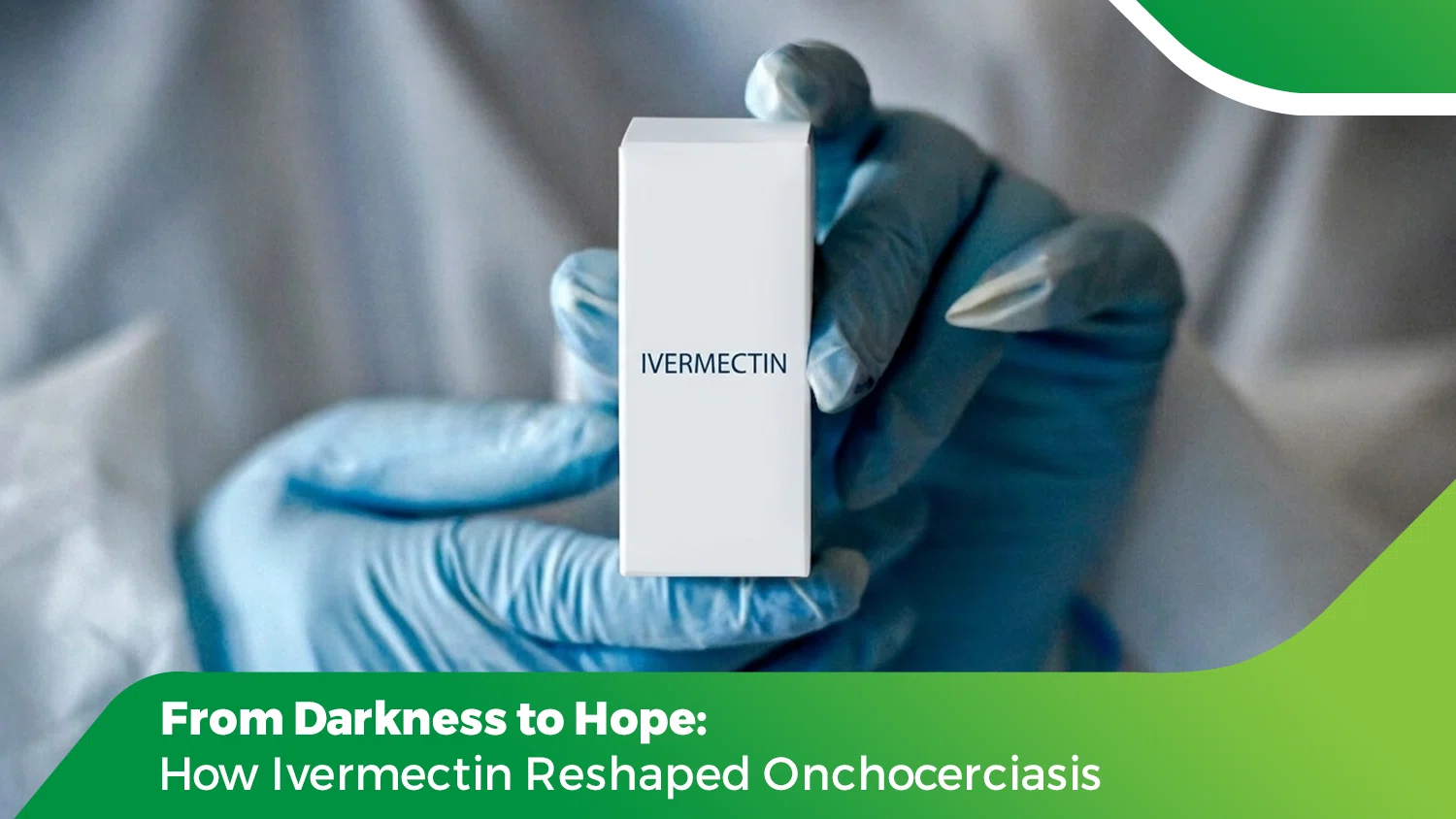

In many remote areas like Sub-Saharan Africa there was a time when darkness didn’t just fall at night- it settled permanently in the eyes of the ones infected.
Children learned to guide their blind parents.
Farmers abandoned fertile lands near the river.
The entire community used to live in fear of a silent, relentless disease called Onchocerciasis often known as river blindness.
This is the story of how one medication can transform lives.
Iverhuman 12 mg reshaped the fight against Onchocerciasis. Let me give you a ride on how it was done.
The invisible enemy
Onchocerciasis is caused by a parasite transmitted through the bite of an infected blackfly of the genus Simulium, which breeds in fast-flowing rivers and streams. Once inside the human host, the larvae matures into adult worms forming nodules below the skin. As they continue to mate and produce microfilariae, communities must be treated for a minimum of 10 to15 years to eliminate transmission, corresponding to the lifespan of the adult O. volvulus.
The consequences are devastating:
- Intense itching and skin damage
- Slow degradation of vision
- Eventually leading to irreversible blindness
In 2024, at least 252.3 million people required preventive treatment against Onchocerciasis. For decades, this disease has robbed millions of people not just out of sight- but out of independence, dignity and opportunity.
Shifting from darkness to hope
Before 1987, the treatment options for Onchocerciasis were toxic or caused severe adverse effects. Ivermectin, a derivative of avermectin, was a truly revolutionary drug, unprecedented in many ways. Ivermectin was originally used for veterinary treatment but in the clinical trials it was observed that it was a safe and highly effective treatment for microfilariae.
There was a program named Mectizan Donation Program where Merc & Co. Inc. committed to provide the drug for free which allowed massive, sustained treatment campaigns.
Through large scale initiatives led by WHO, Iverhuman 12 mg was delivered to affected communities on a large scale.
It was not just a new drug-it was a strategy.
How Ivermectin works against Onchocerciasis
Iverhuman 12 mg does not go and kill the parasite immediately. Instead, it targets the microscopic larvae responsible for the most severe symptoms.
Here’s what it does:
- Paralysis of Parasites
Iverhuman 12 mg binds to glutamate-gated chloride channels, it increases the cell permeability to chloride ions which causes hyperpolarization of the cell, leading to paralysis and death of parasites.
- GABA Agonist
It is believed to act as an agonist of the neurotransmitter GABA which disrupts the GABA mediated CNS transmission in parasite drugbank.
With repeated doses over time, the cycle of infection is gradually broken down.
Radical Reduction of Disease Burden
Iverhuman 12 mg dramatically reduced the impact of the diseases by killing the microfilariae that causes damage even though it doesn’t kill the parasite.
Preventing blindness: Regular, annual treatment kills the larvae before they invade the eyes, reducing the risk of new blindness and severe eye inflammation. If you start using the medication at the early stage of disease, it will help to eradicate the disease in most of the humans.
Ivermectin proved to be even more of a ‘Wonder drug’ in human health, improving the nutrition, general health and wellbeing of billions of people worldwide ever since it was first used to treat Onchocerciasis in humans in 1988. It was proven ideal in many ways be it effectiveness, broad spectrum, safe and easy administration.
From Mass Treatment to Mass Transformation
One of the most remarkable aspects of Iverhuman 12 mg is its use in community based treatment programs.
Villages themselves became a part of the solution:
- Volunteers distributed the medications among infected people
- Annual or biannual dosage became a routine
- Awareness and participation increased majorly
What started as a simple program was now a part of every household. Every person wanted to participate actively in the campaign and help the people infected. This grassroot approach ensured that the treatment reached the most remote parts of the country.
More than just the Medicine Impact
The results have been extraordinary. People began to see differences in overall development and not only in disease conditions. Millions of people were saved from blindness. The infection rates fell down drastically in many regions. The abandoned lands were now turning to be home for many people. In some areas, the transmission has been eradicated. But the transformation goes really deeper.There are some of the amazing transformations that can be seen in such remote regions like:
- Restored lives
Many lives were restored. People not only regained their vision but also their independence and the passion to live their lives.
- Economic revival
When the disease spread drastically many farmers abandoned their lands which dropped down the economy of the place. But as the disease came in control, the farmers got an urge to return to their field
- Generational change
The children had the ability to go to schools, universities and complete their education rather than caregiving.
Challenges that still remain
Even though the treatment has been a success, still there are challenges that remain below the surface. Despite remarkable progress, the journey is still not over. The struggle is still ongoing and many organizations are trying to help to change the situation.
- Some regions still face the ongoing transmission
- Consistent access to medication remains critical
- Monitoring and follow-up programs are essential
Sustained efforts can make it possible for the gains to remain still and not reverse.
Final Thought
The story of Onchocerciasis is no longer just about suffering-its about resilience, efforts, innovation and the access to treatment options.
Sometimes the most profound changes in global heal;th doesn’t come from innovative technologies-they come from the right solution that is available for people at the right time.
From darkness to hope, this is more than a medical breakthrough-it’s a reminder of what’s possible when science meets compassion.
FAQs
- What is Onchocerciasis?
Onchocerciasis is a parasitic infection caused by the worms transmitted through the bites of infected blackflies.
- Can Ivermectin completely cure Onchocerciasis?
Ivermectin does not immediately kill adult worms, so it is not a one-time cure. However, repeated doses over time effectively control the infection and significantly reduce disease transmission.
- Is Ivermectin safe for long-term use?
Yes, when used as directed in mass drug administration programs, Ivermectin has been proven to be safe and effective over long periods.
- Is Onchocerciasis still a global health concern?
Yes, although significant progress has been made, Onchocerciasis remains a concern in some regions, and ongoing efforts are needed to eliminate it completely.
Leave a Comment