
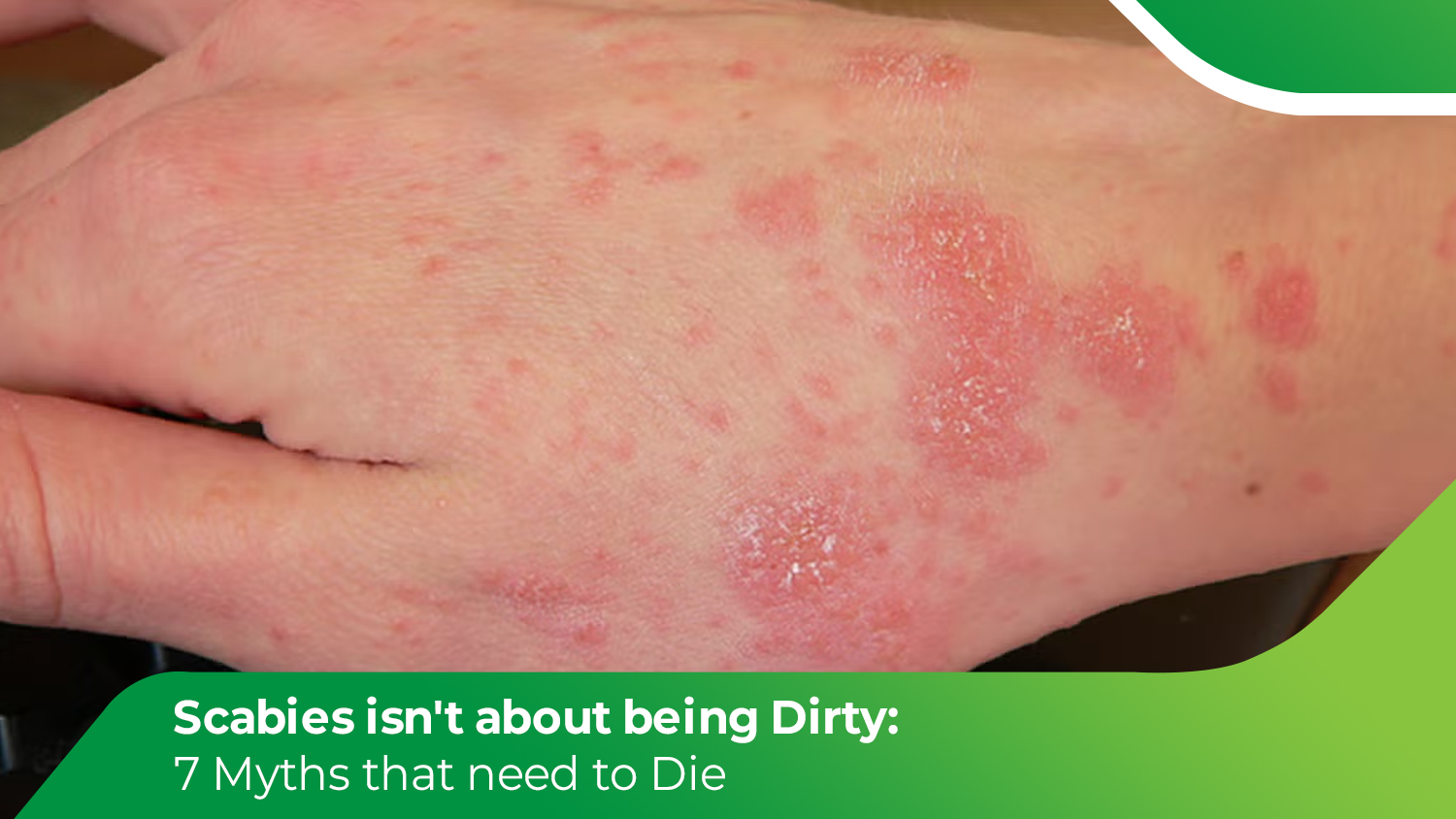

Scabies is the most common dermatological condition that accounts for a proportional amount of skin diseases in developing countries. Globally it affects more than 200 million people at any time and more than 400 million people cumulatively every year. It is one of the most misunderstood topics in the world. Scabies carry a social stigma far heavier than the condition itself. Scabies has nothing to do with personal hygiene but still many people fear being judged as ‘unclean’.
Scabies is a parasitic infectioncaused by tiny mites that burrow into the skin and lay eggs which causes intense itching and rashes. It can affect anyone regardless of the age, cleanliness, lifestyle conditions. Yet there are so many myths in the air regarding the condition.
It’s time to set the record straight! Let’s bust the myths regarding Scabies- once and for all!
Myth 1: Scabies happen only to people who are dirty
This is the most damaging and persistent myth and it’s completely false.
Scabies is caused by a tiny mite called Sarcoptes scabiei that burrows into the top layer of the skin. It usually spreads through extended skin contacts, and not through sweat, dirt or bad hygiene.
There are higher chances of contracting scabies despite you showering twice daily, wearing clean clothes and maintaining all the required hygiene.
In fact, scabies outbreaks are common in:
- Nursing homes
- Hospitals
- Schools
- Day care centres
- Dormitories
- Refugee camps
These environments have one thing in common: close human contact, not poor cleanliness.
Truth: Clean people get scabies too. The blog on hygiene mistakes, shows that sometimes over cleanliness does not show any changes.

Myth 2: Having Scabies Is Something to Be Ashamed Of
This myth causes the most harm of all.
Scabies is:
- Widespread
- Can be treated
- Fugacious
Fear of judgement and embarrassment has made many people hesitant towards the treatment opportunities. This delay can lead to:
- Worsening symptoms
- Secondary skin infections
- Spread of the disease
Scabies should not be ignored because there is no shame in having scabies.
The people around you along with yourself are protected when you seek early treatment for the disease.
Truth: It’s not awkward to treat scabies but it is the most important thing to do.
Myth 3: Scabies Always Looks the Same
Scabies does not have a “one-size-fits-all” appearance.
It can present as:
- Small red bumps
- Blisters
- Patches that look like scales
- Burrow lines
- Nodules
- Severe crusting
Scabies can appear in unusual areas like face, scalp, or nails in geriatrics, paediatrics and patients with weak immunity.
Truth: Scabies can look very different from person to person.
Myth 4: Scabies Will Go Away on Its Own
Scabies does not resolve without treatment.
Left untreated, scabies can:
- Be passed on to others
- Cause severe skin damage
- Lead to bacterial infections
- Cause complications like eczema or impetigo
When waiting in such conditions, it only gets worse.
Truth: Scabies requires medical treatment to be fully treated.
Myth 5: One Application of Treatment Is Always Enough
A lot of folks discontinue their therapy too soon. Most treatment for scabies including Iverguard works by killing the mites and not destroying it completely which means the cycle starts again in a few days.
Some cases require:
- A second application after 7 days
- Taking care of all the household members at the same time
- Oral medication for severe or crusted scabies
Taking care of all the household members at the same time
Oral medication for severe or crusted scabies
Stopping early increases the risk of persistence or recurrence.
Truth: Proper completion of treatment matters more than speed along with avoiding the. Common mistakes associated with scabies treatment.
Myth 6: Once Treated, the Itching Should Stop Immediately
After treatment is done, many people still experience itching and assume that the medication didn’t give the desired results.
Let me highlight the truth: Post-scabies itching is perfectly normal.
The mites might be killed, but your immune system will still react to:
- Dead mites
- Eggs
- Waste materials
The post-scabies itching usually lasts for 2-4 weeks or longer. Soothing lotions, antihistamines, and mild steroids are prescribed by the doctors to manage the symptoms.
Truth: Persistent itching doesn’t always mean treatment failure.
Myth 7: Scabies can spread by being near someone
A very important thing that needs to be kept in mind is that scabies does not spread through casual contact.
You cannot get scabies from:
- Hand shakes
- Sitting next to someone
- Having a conversation
- Being in the same room
Transmission usually requires prolonged, direct skin-to-skin contact, such as:
- Sleeping in the same bed
- Sexual contact
- Caring for an infected person
In very few cases, Scabies can be spread by sharing towels, clothing or bedding especially when they were used by the patient who has been affected by scabies right now.
Truth: Scabies is not an air-borne disease. It doesn’t jump, fly, or spread through the air.
What You Should Know Instead
Let’s replace myths with facts:
Scabies can affect anyone
Cleanliness does not prevent scabies
Getting treatment early speeds up the recovery process
Treating close contacts is important
Talking about it openly lowers stigma and spread
Healthcare professionals view scabies as a normal medical condition, not a sign of personal failure. You should too.
Breaking the Stigma Starts with Education
The idea that scabies is linked to dirt, neglect, or poor character is outdated and harmful. These myths isolate people, delay care, and allow the condition to spread silently.
By talking openly about scabies-what it is, how it spreads, and how easily it can be treated-we replace shame with knowledge and fear with facts.
If you or someone you know has symptoms of scabies, don’t panic and don’t hide. Get informed, seek medical advice, and treat it promptly.
Because scabies isn’t about being dirty-it’s about being human.
Conclusion: Let Knowledge Replace Shame
Scabies has been in the world for ages, not because it is dangerous but because it is misunderstood. The mites have not done much damage then the myths surrounding scabies have done turning a common and treatable skin condition into a source of fear, silence, and stigma.
Scabies is not a reflection of hygiene, character, or lifestyle. It is a parasitic skin infection that spreads through close contact and can affect anyone, anywhere. When myths are believed, people delay treatment. When treatment is delayed, scabies spreads. And when it spreads, the stigma only grows stronger.
Awareness plays an important role in breaking this cycle. By understanding the facts, seeking timely medical care, and talking openly without judgment, we protect ourselves and those around us. Scabies does not define a person-it only signals the need for treatment.
Because scabies isn’t about being dirty.
It’s about being human-and choosing knowledge over fear.
FAQs
1. Is scabies caused by poor personal hygiene?
No. Scabies has nothing to do with cleanliness. It is caused by a microscopic mite that spreads through prolonged skin-to-skin contact. Even people with excellent hygiene can get scabies.
2. Can pets spread scabies to humans?
Human scabies is caused by a mite specific to humans. Pets cannot transmit human scabies.
3. When should I see a doctor for scabies?
You should seek medical advice as soon as you notice persistent itching, rashes, especially in cases where the symptoms worsen overnight.
4. If one person is infected by scabies, do all family members need treatment?
Yes. All household members should be treated at the same time-even if they experience no symptoms.
Leave a Comment