
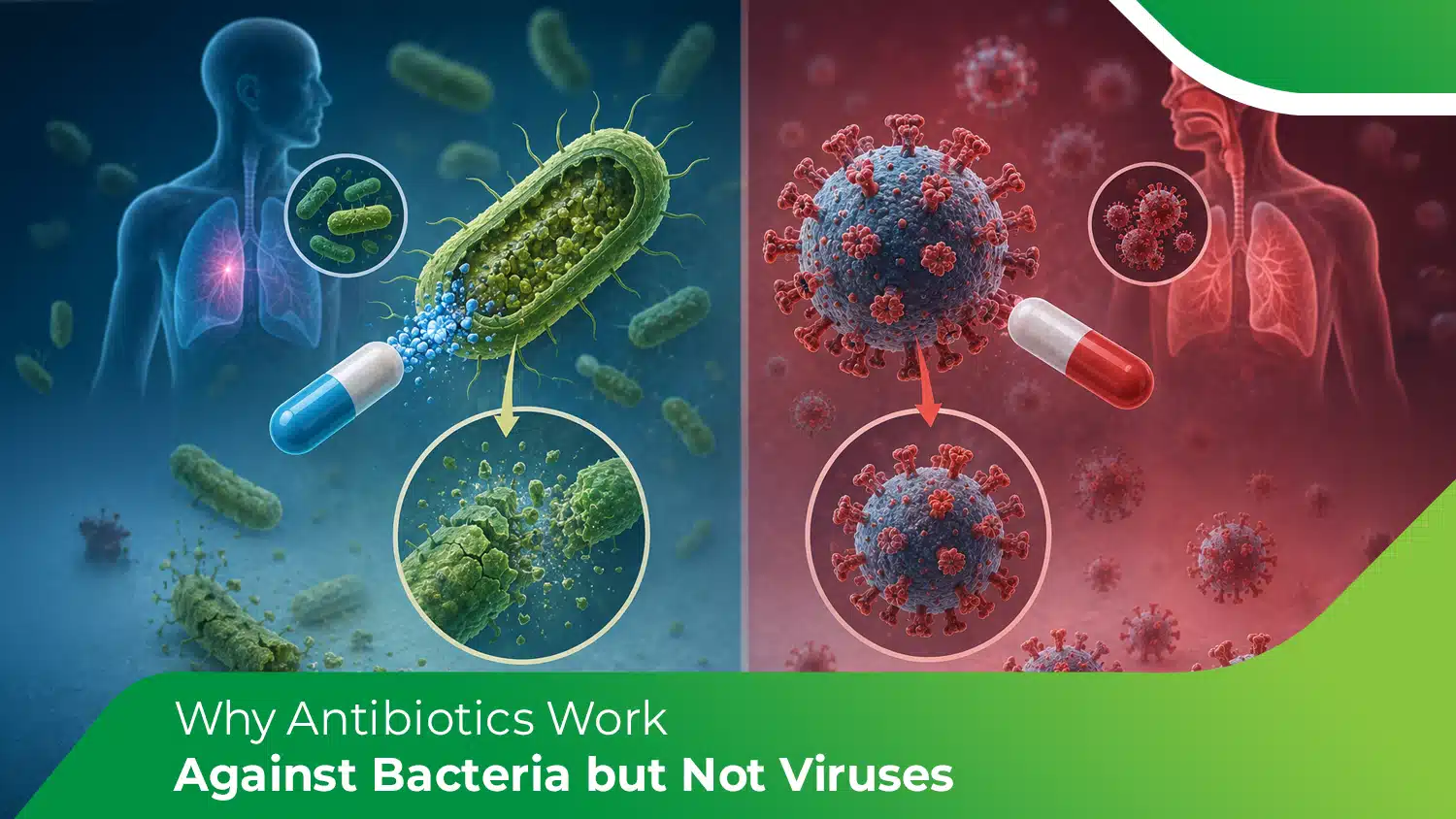

A lot of people still mix this up. Honestly… it’s understandable. You get sick. Your throat hurts. Fever shows up. You feel terrible for three days straight and suddenly someone says, “Just take antibiotics.” Sometimes doctors prescribe them. Sometimes they don’t. And that’s where people get annoyed because it feels inconsistent.
But the strange thing is… antibiotics were never meant to fix everything in the first place. They only work on certain living things. Tiny ones. Specific ones. And viruses? Completely different story. Not “slightly different.” Entirely different.
That’s really the center of all this confusion.
The weird thing about bacteria
Bacteria are alive. Tiny, microscopic, kind of creepy if you think about it too long, but alive. They eat, multiply, and react to their surroundings. Some are helpful, actually. Your gut is full of them right now. Others are the reason people end up with strep throat, urinary tract infections, bacterial pneumonia, skin infections… stuff like that. These are all infections caused by bacteria. And because bacteria have actual cell structures and internal machinery, antibiotics can target them.
That’s the key part people miss.
Antibiotics don’t just “kill germs” in some vague movie-style way. They attack specific systems inside bacteria. Some antibiotics break bacterial cell walls. Some stop protein production. Some interfere with DNA replication. Basically the bacteria can’t survive after that. Or they stop multiplying long enough for your immune system to clean up the rest.
Viruses are… honestly kind of strange
Viruses aren’t really alive in the same way. That sentence alone throws people off. A virus doesn’t function independently like bacteria do. It can’t reproduce alone. It can’t really “do” much until it enters your cells. So instead of being a full living cell, it’s more like genetic material wrapped in a shell. Which sounds simple. But that simplicity is exactly why antibiotics fail against viruses.
There’s nothing for the antibiotic to attack.
No bacterial wall. No bacterial machinery. No bacterial processes. The virus hides inside human cells and uses those cells to multiply. And if an antibiotic attacked those human cells too aggressively, well… that would be bad. Really bad.
People still ask for antibiotics when they have a cold
This happens constantly. Someone gets the flu or a sore throat or a sinus issue and assumes antibiotics will speed things up. Sometimes people even feel better after taking them and think, “See? It worked.”
Or maybe the body was already recovering naturally. A lot of viral illnesses improve on their own after several days, which makes it easy to give antibiotics credit they didn’t earn. Colds are viral. Flu is viral. COVID was viral. Most coughs and runny noses people deal with every year are viral too. That’s why physicians sometimes refuse antibiotics even when patients are clearly miserable. It’s not because they don’t care. It’s because the medicine literally won’t do the thing people expect it to do.
How antibiotics changed medicine forever
When antibiotics work….they’re incredible. Before antibiotics existed, even small bacterial infections could become deadly. A cut on the skin. A tooth infection. Pneumonia. Things we barely think about now used to kill huge numbers of people. Then penicillin arrived and suddenly bacterial infection treatment changed completely. Not perfectly, obviously. Medicine is never perfect. But survival rates improved fast.
Surgeries became safer too because doctors finally had a way to control dangerous bacterial infections afterward. It’s hard to overstate how massive that shift was. Honestly, A-mox 250 mg probably changed modern healthcare more than most people realize.
But people overused them for years
A-mox 250 mg became so common that they started getting prescribed for almost everything. Sometimes unnecessarily. Sometimes because patients insisted. Sometimes because physicians wanted to be cautious and prescribe “just in case.” Over time, bacteria adapted. That’s the scary part.
Bacteria evolve quickly. Faster than humans usually think about. So when antibiotics like A-mox 250 mg are used too often, some bacteria survive and learn resistance tricks. Then those resistant bacteria spread. Now certain infections are much harder to treat than they used to be. Which is why physicians today are more careful about prescribing antibiotics for viral illnesses. Using antibiotics when they aren’t needed doesn’t just fail to help. It can create larger problems later.
The body usually handles viruses differently
When you catch a virus, your immune system does most of the heavy lifting. Rest matters. Fluids matter. Time matters more than people want it to. That’s frustrating because humans love quick fixes. One pill. Done. Viruses don’t always cooperate with that idea.
There are antiviral medications for certain viruses, yes. But antivirals are not the same thing as antibiotics. Different targets entirely. Different mechanisms. Different outcomes sometimes too. And virus treatment options often focus more on reducing severity or shortening illness rather than completely “destroying” the virus overnight. Which people sometimes misunderstand as the medicine not working.
It gets confusing because symptoms overlap
This is probably why the misunderstanding never really disappears. Bacterial infections and viral infections can feel almost identical in the beginning. Fever. Fatigue. Swollen throat. Coughing. Congestion. You can’t always tell from symptoms alone.
Even physicians sometimes need tests to confirm what’s causing an illness. A sinus infection might begin viral and later become bacterial. Bronchitis is often viral, but not always. Ear infections can go either way too. So patients see overlap and assume the treatment should overlap too. Makes sense emotionally, honestly.
Scientifically though… not really.
The phrase “superbug” sounds dramatic until you read about it
Antibiotic resistance used to sound like distant science news. Now it’s everywhere. Hospitals deal with resistant bacteria constantly. Some infections now require stronger medications with harsher side effects because older antibiotics stopped working well enough. And occasionally there are strains resistant to nearly everything available.
That’s terrifying when you think about routine surgeries or infections becoming dangerous again. This is one reason physicians push back against unnecessary antibiotic use. Not because antibiotics are bad. Because they’re valuable. And losing effective antibiotics would be a disaster.
Some people stop antibiotics early too
A person starts feeling better halfway through treatment and decides they’re done. But surviving bacteria can remain in the body. Those bacteria may come back stronger or more resistant. Physicians usually recommend finishing the full course for exactly this reason. Though honestly, recommendations have evolved over time and sometimes depend on the infection itself. Medicine changes. Research changes. Nothing stays frozen forever.
Still, randomly stopping medication early is generally not a great idea.
The flu example explains a lot
Take influenza. People get body aches, fever, exhaustion, and coughing. They feel horrible. Some still ask for antibiotics immediately. But the flu is caused by a virus. So antibiotics don’t attack it.
Physicians might recommend antivirals in some situations, especially early on or for high-risk patients. But often the main advice is rest, hydration, fever management, monitoring symptoms. Which sounds disappointingly simple when someone feels awful. But simple doesn’t mean ineffective. The immune system is doing a huge amount of work during viral illness even when it feels like nothing is happening.
How antibiotics work is actually kind of brilliant
It’s strange when you think about it long enough. Scientists figured out ways to exploit differences between bacterial cells and human cells. That’s why antibiotics can harm bacteria without automatically destroying us. Some prevent bacteria from building protective walls. Others interrupt bacterial ribosomes, which are involved in protein production.
Human cells are different enough that the medication can target bacteria more specifically. Not perfectly. Antibiotics like A-mox 250 mg still cause side effects sometimes. But selective targeting is what made them revolutionary in medicine.
Viral infections can still become serious though
People sometimes hear “it’s viral” and assume that means harmless. Definitely not true. Viruses can absolutely become dangerous. Some lead to severe lung infections, organ complications, long-term inflammation, neurological symptoms… all kinds of things.
The issue isn’t whether viruses are serious. The issue is that antibiotics are simply the wrong tool against them. It’s like trying to unlock your house using a car key. Doesn’t matter how important the house is. The tool is wrong and that is not going to work.
The internet made antibiotic myths worse somehow
There’s endless misinformation online now. People swap random medication advice in forums or social media comments like they’re trading recipes. “Antibiotics cured my cold.”“Take leftover antibiotics.” “This one works for everything.” No. Not really.
Taking antibiotics unnecessarily can cause allergic reactions, stomach problems, yeast infections, resistant bacteria issues… and still not help the illness itself. Which is frustrating because people often want certainty when they’re sick. And medicine sometimes answers with uncertainty instead.
Why antibiotics don’t cure viruses comes down to one thing
Biology. That’s really it underneath all the confusion. Bacteria and viruses are fundamentally different organisms. Antibiotics were designed to interfere with bacterial structures and functions. Viruses don’t have those same structures. So the medication has nothing useful to attack. Simple idea. But it affects millions of doctor visits every year.
FAQs
- Can antibiotics help with the common cold?
No. The common cold is caused by viruses, not bacteria.
- Why do physicians sometimes test infections before prescribing medicine?
Because they may need to identify whether it’s bacterial or viral first.
- Are antivirals the same as antibiotics?
No. Antivirals target viruses, while antibiotics target bacteria.
- Can taking antibiotics too often be harmful?
Yes. Overuse can lead to antibiotic resistance and side effects.
- Do bacterial and viral infections feel similar?
Very often, yes. That’s part of why people get confused.
Leave a Comment