
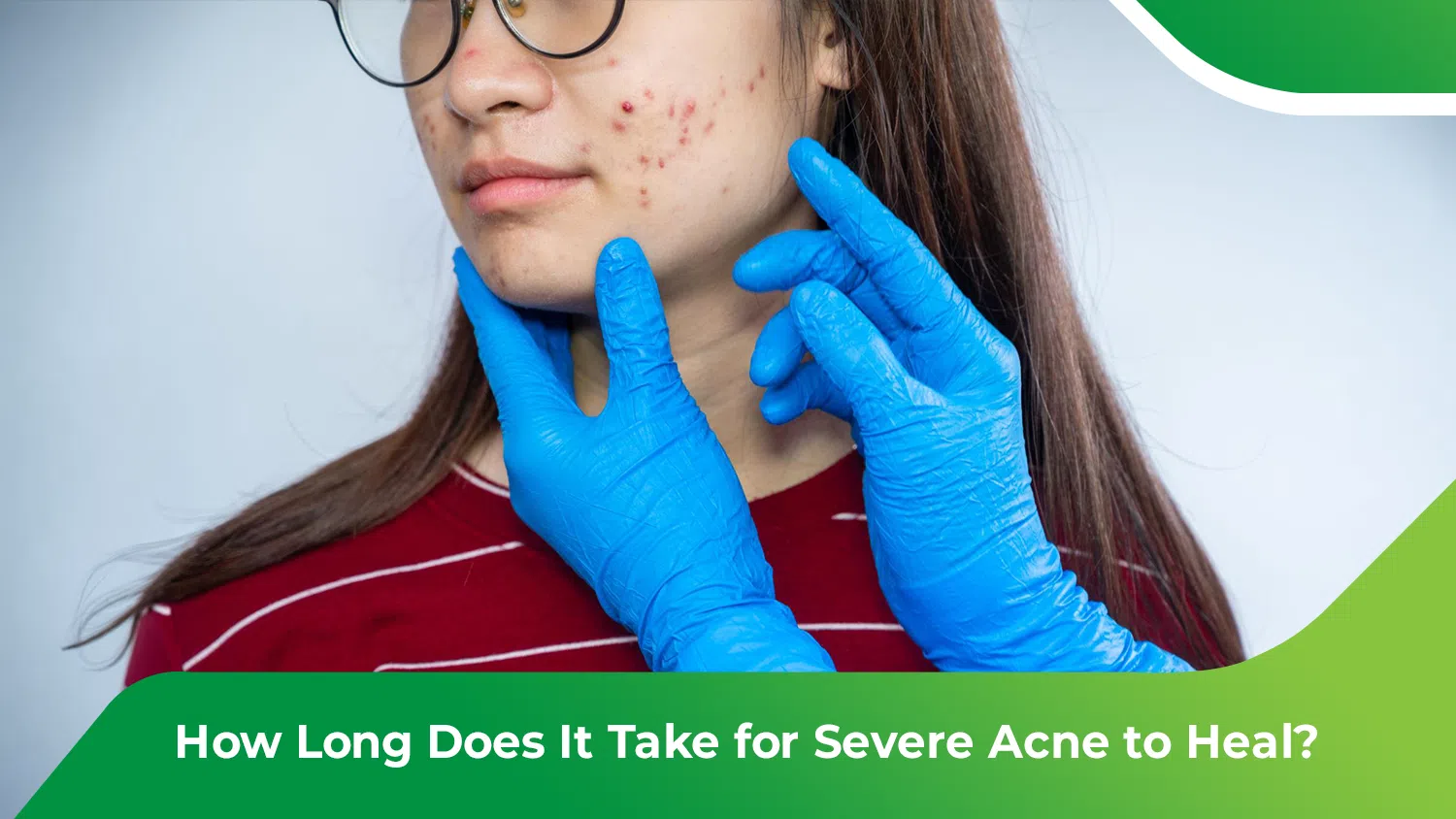

If you’re dealing with deep, painful breakouts, the first question is usually pretty simple: when will this finally calm down?
The annoying part is that there isn’t one fixed answer. A small breakout can settle fairly quickly. Deep nodules and cysts can hang around much longer, and even after the active spots flatten, the skin may still look red or uneven.
The answer depends on how deep the breakouts are, what is causing them, and whether you’re actually treating the problem or just waiting for it to pass.
For some people, improvement starts within several weeks. For others, getting the skin properly under control can take a few months. And yes, that can feel like forever when you’re checking your face every morning.
Why deep breakouts take so long
Severe acne is different from the occasional spot that appears before an event and disappears a few days later.
Deep nodules and cysts form further inside the skin. They can be painful, swollen and stubborn. The inflammation is happening below the surface, so squeezing or scrubbing the area usually doesn’t make things move faster. It can actually make the situation worse.
This is one reason cystic acne can feel so unpredictable. One bump may shrink slowly while another seems to appear overnight.
There’s also the fact that new spots can keep forming while older ones are healing. So you might think nothing is improving even when individual lesions are actually getting smaller.
That’s frustrating, but it’s pretty common.
So, what is a realistic healing timeline?
There’s no stopwatch for skin.
With appropriate care, you may notice less redness, swelling or tenderness within a few weeks. Bigger changes often take longer. The American Academy of Dermatology notes that treatment may take two to three months before clear improvement becomes noticeable.
The severe acne recovery time can also depend on the treatment being used. A topical medicine may take several weeks to build an effect. Oral medicines can also take time, and dermatologists may adjust the plan if the first approach isn’t doing enough.
Then there is isotretinoin.
For people whose breakouts have not responded to other treatment, dermatologists may consider isotretinoin. A typical course is around four to five months, although treatment can be shorter or longer depending on the person and the dose.
It’s worth knowing that isotretinoin does not always mean instant improvement. Some people experience a temporary worsening during the first one to two months before their skin starts clearing.
So if your skin looks worse at the beginning, it does not automatically mean the treatment has failed. But it is something to discuss with the dermatologist managing your treatment.
What actually helps the skin heal?
The biggest mistake is often trying to do everything at once.
One cleanser. One treatment. Then another cream because someone online said it worked. Then a scrub. Then a drying spot treatment.
It sounds familiar because a lot of people do it.
The better approach is usually much less exciting: use a treatment plan suited to your type of acne and give it enough time to work.
A dermatologist may use topical retinoids, benzoyl peroxide, antibiotics or other medicines depending on what your skin needs. Current AAD guidance also recommends isotretinoin for people with deep, difficult-to-treat breakouts or those who have not responded adequately to standard topical or oral therapy.
Prescription acne treatment may be considered when over-the-counter products are not controlling deep or persistent breakouts.
And don’t underestimate basic skin care. A gentle cleanser, a non-comedogenic moisturiser and daily sunscreen can make the whole process easier, especially when treatment leaves the skin dry or sensitive.
Where does the Saferet 30 mg capsule fit in?
Saferet 30 mg Capsule is a prescription isotretinoin product used for certain difficult forms of acne. It should not be treated like an ordinary pharmacy acne product or started casually.
If a dermatologist considers isotretinoin appropriate, the dose and duration are based on the individual patient. Monitoring is important because isotretinoin can cause significant side effects and has strict pregnancy-related safety requirements. In the US, isotretinoin is subject to the FDA’s iPLEDGE REMS because of the risk of serious birth defects.
The Saferet 30 mg capsule should therefore be used only according to a qualified healthcare professional’s instructions.
This matters even more if pregnancy is possible, if you are taking other medicines or supplements, or if you have existing health concerns. Isotretinoin is a powerful medication, not a quick cosmetic fix.
What if the spots are gone but the marks are still there?
This is where people sometimes think treatment has failed.
The active breakouts may have settled, but the skin can still have dark marks, redness or texture changes. The acne healing process doesn’t necessarily end on the day the last pimple disappears.
Scars can take much longer to improve than active spots. Some fade gradually, while deeper marks may need separate dermatological procedures or treatments.
This is also why picking at deep spots is such a bad trade-off. You get a few minutes of satisfaction and potentially a much longer problem.
If you already have acne scars, a dermatologist can tell you whether the marks are temporary discoloration or true scarring and what can realistically be improved.
What can make healing slower?
Sometimes it isn’t just the medicine.
Picking or squeezing lesions can increase irritation. Constantly changing products can also make the skin barrier unhappy. And stopping treatment every time your skin looks slightly better can allow new breakouts to return.
Hormonal changes can matter too. So can genetics, certain medicines and other individual factors.
Persistent acne deserves a proper assessment rather than an endless cycle of trying random products.
If your acne is painful, widespread, leaving marks, or affecting your confidence, seeing a dermatologist earlier is usually more sensible than waiting for it to disappear on its own. The AAD notes that untreated deep acne can persist for years and that professional treatment can help clear the skin and prevent new scars.
How to heal severe acne without making things worse
There is a temptation to attack the skin harder when nothing seems to work.
More washing. More exfoliating. Stronger products. Scrubbing until the face feels “squeaky clean.”
That usually isn’t the answer.
Keep cleansing gentle. Avoid picking. Use products that don’t clog pores. Wear sunscreen, particularly if your treatment makes your skin more sensitive to sunlight.
And most importantly, stick with the plan you were given long enough to judge it properly.
If you’re wondering what actually helps, the answer is rarely one miracle product. It is usually the right diagnosis, a suitable treatment plan, patience and some boring consistency.
That last part is probably the hardest.
When should you speak to a dermatologist?
If large, painful spots keep appearing, if your acne is leaving scars, or if store-bought products have made little difference, it’s time to get professional advice.
You don’t have to wait until your face is covered before asking for help.
A dermatologist can work out whether you actually have severe acne, what type it is, and whether you need topical medicines, oral treatment or something stronger such as isotretinoin.
For people with acne-prone skin, getting treatment early can also help reduce the chance of long-lasting marks.
And if isotretinoin is being considered, regular medical monitoring is part of the process. It is not something to buy and use without supervision.
The short answer
So, how long does severe acne take to heal?
Think in weeks and months rather than days.
Some people start seeing improvement after a few weeks. A fuller response may take two to three months or longer, depending on the treatment. Isotretinoin courses commonly run for several months, and the skin can continue changing after treatment ends.
There is no single timeline that applies to everyone.
If your skin is painful or keeps getting worse, don’t just keep waiting. Getting the right treatment sooner can make the whole process less drawn out.
FAQs
- How long does severe acne usually take to heal?
It can take several weeks to months, depending on severity and treatment.
- Can severe acne go away on its own?
It can improve, but deep acne may persist for years without effective treatment.
- How long does isotretinoin treatment usually last?
A course often lasts around four to five months, but the duration varies.
- Can acne leave permanent marks?
Yes. Deep breakouts can leave lasting marks, especially when lesions are picked or squeezed.
- Should I use isotretinoin without a prescription?
No. Isotretinoin requires medical supervision because it can cause serious side effects and has strict pregnancy safety requirements.
Leave a Comment