
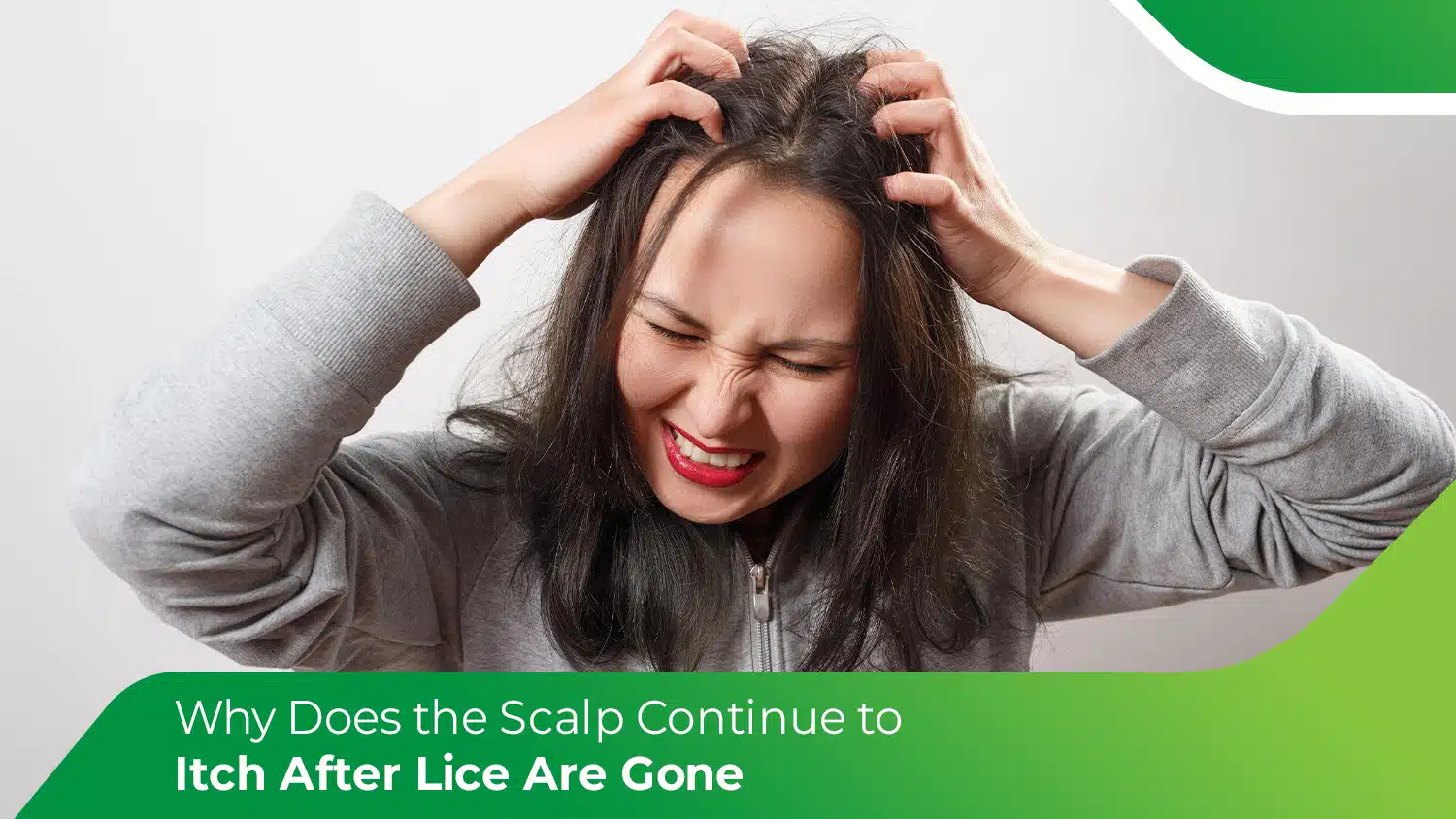

So you did the treatment. Maybe even twice, because the first round never fully convinces anyone. You checked for nits under a lamp, combed it out, and washed the sheets, the whole thing. And yet the scalp itching is still there. Not as bad, maybe, but there. Which honestly feels a little unfair.
This is more common than people admit out loud. Nobody wants to say “I still have head lice symptoms” three weeks after treatment because it sounds like the treatment failed, or like you’re lying about checking properly. But that’s not usually what’s going on.
It’s gone, but your scalp didn’t get the memo
Here’s the thing nobody explains well. The lice infestation itself can be completely over no live bugs, no eggs hatching, nothing moving around up there and your scalp still reacts like something’s crawling on it. That’s not in your head. Well, it is literally in your head, but you know what I mean.
Scalp itching after lice treatment happens for a few overlapping reasons, and most articles list them like a neat little checklist, which honestly makes it seem more orderly than it actually feels when you’re the one dealing with it.
The bites don’t just switch off
Lice bites cause an allergic-type reaction. Your immune system reacts to the saliva they leave behind when they feed. That reaction doesn’t disappear the second the lice do. It can take days, sometimes a couple of weeks, for the skin to calm down. So the itchy scalp after the lice sensation isn’t really about lice anymore; at that point it’s leftover irritation. Skin remembers, in a way.
I’ve seen people scratch their head raw, convinced there’s a new infestation, only to find out under a comb there’s absolutely nothing there. Just annoyed skin trying to settle.
The treatment itself is part of the problem
This part gets skipped a lot. The shampoos and lotions used to kill lice are not gentle. Some contain permethrin, some pyrethroids, and they’re doing a job on your scalp chemically, not just on the bugs. So on top of the bite reaction, you now have a mild chemical irritation layered over it. Two different itches pretending to be one itch.
Dry scalp, flaking, and a tight feeling all of that can follow. People assume it’s lice again because itching equals lice in their head at this point, which is fair, but it’s not always true.
Nits that are dead still feel real
Empty nit casings can stay glued to the hair shaft for weeks even after the eggs are dead or already hatched and gone. They don’t cause itching by themselves really, but psychologically, seeing them there keeps the whole “something’s on my head” feeling alive. You touch your hair, feel a little bump, and panic a bit. It’s not lice eggs anymore, just leftover casing, but try telling that to your brain at 2 am.
Sometimes it’s genuinely something else now.
This is the part where I’ll admit not every itch after lice is about lice at all anymore. Scalp irritation can be triggered separately by dandruff, dry skin, eczema flaring up because you scratched too much, or even a mild secondary skin infection from broken skin. Scratching breaks the surface, bacteria get in, and now there’s a new low-grade irritation happening that has nothing to do with the original lice infestation.
It’s kind of ironic. The scratching meant to relieve the itch ends up creating a second itch.
Medicated shampoos leave residue too
People rinse and think that’s it, done, clean. But some treatments leave a slight residue on the scalp for a bit, and that residue itself can be mildly irritating, especially on sensitive skin. It’s not dangerous, just annoying, and it adds to why the scalp itches after lice are gone even when everything technically “worked.”
Where oral treatment sometimes comes in
For infestations that don’t respond well to topical products, or keep coming back in a household, doctors sometimes move to an oral option. Vermectin 12 mg is one of those, prescribed in cases where lice resist the usual creams or shampoos, or when reinfestation keeps happening despite doing everything right. It works differently through the bloodstream rather than sitting on the scalp, which some people actually prefer because there’s less direct scalp contact involved.
Worth saying, though, oral treatment doesn’t mean instant relief from itching either. The scalp still needs its own time to heal after, same as with topical treatment. Vermectin 12 mg kills the lice, sure, but it’s not really addressing the itch part of the equation directly.
So what actually helps in the meantime?
Cool compresses help a bit. A fragrance-free moisturizing scalp treatment, not anything harsh. Antihistamines sometimes, if a doctor’s okay with that for you specifically. Mostly just… time, unsatisfying as that sounds. Nobody likes hearing “wait it out” when their head is itching nonstop.
Avoid retreating too soon out of frustration. That’s a mistake people make a lot: they see a continued itchy scalp and assume the first treatment failed, so they do another round of lice treatment within days, which just adds more chemical irritation on top of already annoyed skin. Sometimes doing nothing extra is the better move.
When it’s worth actually checking with someone
If it’s been more than three weeks and the scalp itching hasn’t eased up even slightly, or if you’re seeing crusting, oozing, swelling, or actual new lice or eggs on a fine-tooth comb check, that’s when it makes sense to see a doctor or pharmacist rather than guessing. Post-treatment itching that lingers this long sometimes needs a proper look, especially if there’s a chance of a secondary infection from scratching.
It’s also fair to just ask a pharmacist directly. They deal with this constantly and can usually tell within a minute whether it’s lingering irritation or something that needs more attention.
A few small habits that seem to help
Nothing dramatic here, just stuff people mention when they’re through it. Switching to a softer, unscented pillowcase for a week or two, oddly enough, seems to make a difference for some people, less friction against already-annoyed skin overnight. Same with tying hair loosely instead of tightly, since tension at the roots can make an already sensitive scalp feel worse than it is.
Hot showers don’t help either, even though they feel good in the moment. Heat tends to wind up irritated skin rather than calm it, so lukewarm water is the better call for a bit. And try not to keep re-checking with a fine-tooth comb every single day out of anxiety, because repeated combing on tender skin can itself keep things stirred up longer than necessary. Give it a few days between checks instead of doing it constantly.
None of this speeds things up massively. It’s more about not making an already annoyed scalp worse while it does its own slow thing in the background.
FAQs
- How long can scalp itching last after lice are gone?
Usually one to two weeks, sometimes a bit longer if the skin got irritated from scratching.
- Does itching mean the lice treatment didn’t work?
Not necessarily. Itching often continues even after lice are fully gone.
- Can I use moisturizer on my scalp after lice treatment?
Yes, a gentle, fragrance-free one is usually fine and can actually help.
- Should I repeat lice treatment if I’m still itching?
Not right away. Repeating too soon can irritate the scalp further without new lice present.
- When should I see a doctor about ongoing itching?
If longer than 3 weeks or has swelling, oozing or new lice found.
Leave a Comment